

Insights from the 22nd OCOVA Forum – Mountains of Tomorrow
The 22nd OCOVA Forum Mountains of Tomorrow once again highlighted an issue that has become critical for our territories – especially mountainous areas: how to better understand, anticipate, and manage water resources in the context of climate change.
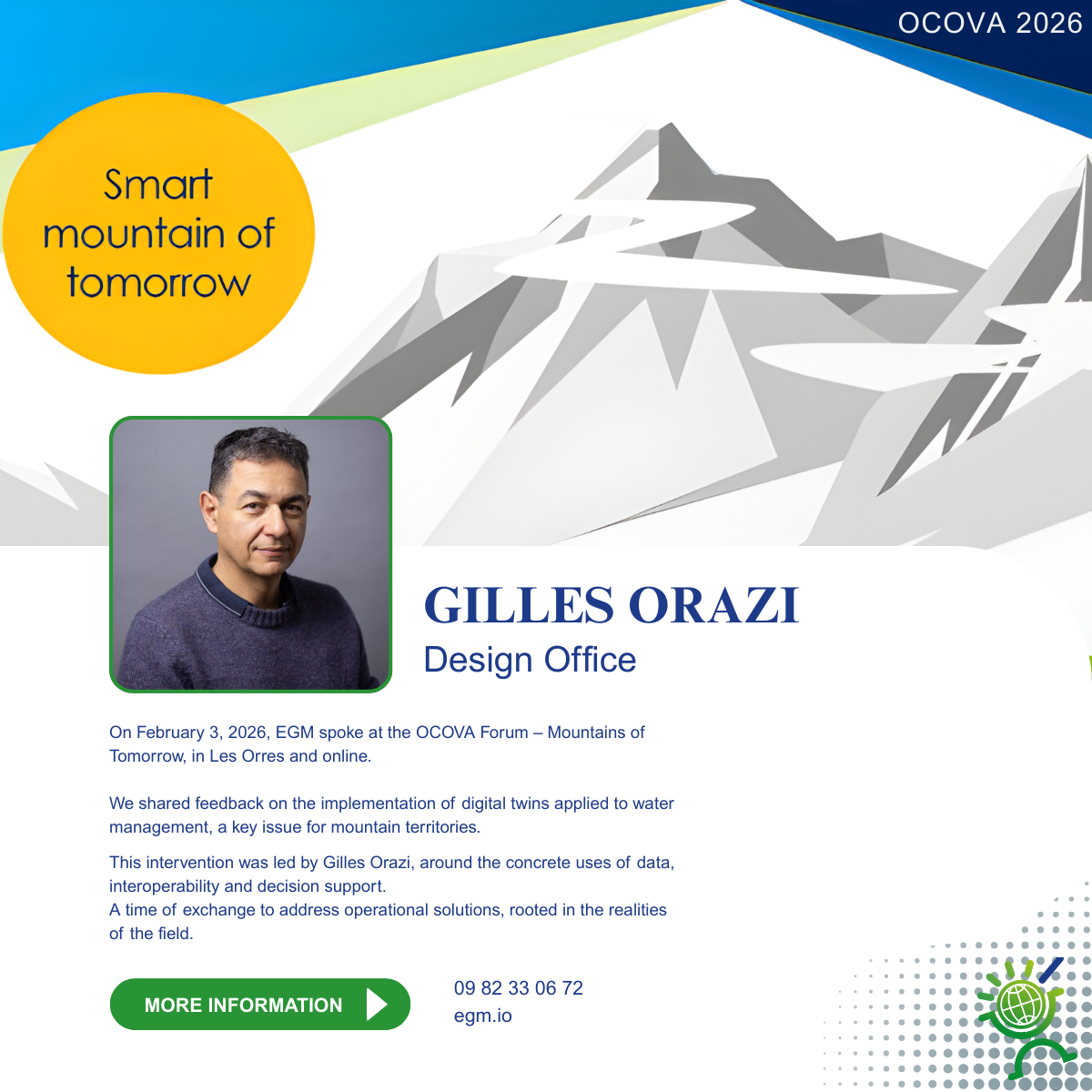
On this occasion, EGM shared its vision and practical experience of digital twins applied to water management, through a presentation delivered by Gilles Orazi, Head of Smart Sensing Unit.
Beyond the concept itself, the forum was an opportunity to reaffirm a strong belief: digital twins are not an abstract technological promise, but a concrete decision-support tool serving territories and their stakeholders.
Digital twins: connecting the physical world to the digital world
The primary purpose of a digital twin is to bridge the gap between the physical world and the digital one. It relies on data collected from the field (sensors, connected objects, existing systems) to represent a real system and transform it into a dynamic, evolving model.
Applied to water management, digital twins make it possible to:
- Describe the actual state of a system (networks, resources, uses)
- Analyze ongoing dynamics
- Predict possible evolutions
- Explore different scenarios
- Prescribe or guide actions
- Diagnose malfunctions or risks
This approach is not entirely new. As early as the 1970s, the World3 model used in Limits to Growth demonstrated the value of systemic modeling to anticipate pressure on resources. Today, the difference is significant: data is available, interoperable, and exploitable in near real time.
From theory to operations: digital twins that deliver value
At EGM, our position is clear: a digital twin only creates value if it is useful, understandable, and actionable.
The key capabilities we develop around digital twins include:
- Descriptive: accurately representing a territory or water system
- Prospective: assessing the impact of decisions or events (droughts, changes in use, infrastructure works)
- Predictive: anticipating critical situations
- Connected: integrating connected objects and data services
In practical terms, this relies on:
- Connected devices to collect field data,
- Data services to process, correlate, and enrich this data,
- Visualization tools to make information understandable,
- Alert management mechanisms to enable timely action.
The role of standards and open source
A key takeaway widely shared during the forum is the need to avoid technological silos.
EGM advocates an approach based on:
- Open solutions,
- Recognized standards,
- Interoperable architectures.
This approach enables:
- Data sharing between models,
- Effort mutualization,
- Long-term system sustainability,
- Better ownership by local stakeholders.
The MARCLAIMED project (2024–2027) perfectly illustrates this philosophy, with the deployment of several interconnected models across pilot sites and a clear ambition to industrialize the design of digital twins for water management.
Supporting decision-making in an uncertain context
Mountain territories are particularly exposed to the effects of climate change: rainfall variability, snowmelt, pressure on uses, and increased risks.
In this context, the digital twin becomes a strategic asset. It does not replace human decision-making, but it:
- sheds light on choices,
- helps objectify discussions,
- allows scenarios to be tested without real-world risk,
- supports more resilient and resource-efficient water management.
Our conviction
At the end of the OCOVA Forum Mountains of Tomorrow, one conclusion stands out clearly: the future of water management will rely on open, interoperable digital tools firmly connected to field realities.
At EGM, we will continue to promote digital twins that are:
- pragmatic,
- interoperable,
- designed to serve territories and their transitions.
Because understanding better today means making better decisions for tomorrow.