

Fields : Smart Cities / Local digital twins / Data / Artificial intelligence / Territorial interoperability
Program : Digital Europe Programme—multi-country project supporting the deployment of the CitiVERSE EDIC LDT
Duration :
Coordination :
Project website : https://ldtcitiverse-edic.eu/build/
BUILD, in two words
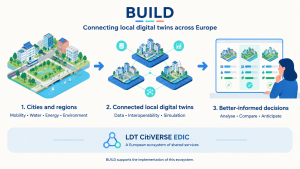
BUILD supports the operational implementation of LDT CitiVERSE EDIC, the European initiative that aims to connect local digital twins of cities and territories.
The project aims to transform sometimes isolated local initiatives into an interoperable European ecosystem, based on secure data sharing, artificial intelligence, common tools and reusable services.
Thanks to BUILD, cities and regions will be able to better understand, simulate and manage their territory: mobility, energy, water, environment, infrastructure, urban planning, air quality or waste management.
The role of EGM
EGM contributes to BUILD by putting its expertise at the service of the digital transformation of territories and the deployment of data-based solutions.
Its contribution focuses in particular on the development and integration of digital services for local authorities, the structuring of territorial use cases, as well as the enhancement of data useful for the management and resilience of cities.
EGM thus participates in the creation of a European ecosystem of interoperable local digital twins, capable of helping public actors to analyze complex situations, anticipate changes in their territory and inform their decisions.
The project
European cities and territories generate a considerable amount of data every day: geographical, environmental, energy, mobility, water, buildings, public facilities or urban services.
However, these data often remain dispersed between several systems, difficult to cross and insufficiently exploited to respond effectively to major urban and territorial challenges.
BUILD addresses this challenge by supporting the implementation of the CitiVERSE EDIC LDT—Local Digital Twins towards the CitiVERSE European Digital Infrastructure Consortium. This European initiative aims to network local digital twins in order to create a common, interoperable and sustainable environment for European cities and regions.
The BUILD project aims to lay the technical, organizational and operational foundations necessary for this ambition. It helps communities to deploy, connect and evolve their local digital twins, while promoting data sovereignty, the reuse of existing solutions and cooperation between territories.
Digital twins for better decision-making
A local digital twin is a dynamic representation of a territory, its infrastructure or services. It combines different data sources with tools for visualization, analysis, modeling, simulation and, when relevant, artificial intelligence.
For example, it may allow a community to:
- Simulate the impact of new urban planning or changes in mobility flows.
- Anticipate the consequences of a heat, flood or climatic event.
- Better monitoring of consumption and optimization of energy networks.
- Improve the management of water, waste, air quality or public spaces.
- Compare several scenarios before making an investment or development decision.
- Share a common understanding of a territory between public services, elected officials, partners and citizens.
The goal is not only to represent the city in three dimensions. It is above all a question of providing the territories with decision-making tools capable of linking physical reality, available data and action scenarios.
A shared European infrastructure
The LDT CitiVERSE EDIC does not seek to centralize all European urban data in a single platform. Its ambition is based on a federation logic: each city or territory retains control over its data and digital environment, while being able to connect to common services, standards and components.
BUILD helps to bring out this shared infrastructure by working on:
- Interoperability between platforms, data formats and digital solutions.
- The connection between different local digital twins on a European scale.
- The development of common services for cities and regions.
- The integration of analysis, simulation and artificial intelligence capabilities.
- The implementation of concrete and reproducible use cases.
- Supporting local authorities in their digital skills development.
- The development of a European community bringing together public actors, companies, networks and experts.
This approach should reduce the fragmentation of initiatives, avoid the multiplication of isolated solutions and make digital investments more useful, more sustainable and easier to replicate.
The expected results
BUILD will help to develop a European ecosystem of local digital twins and associated services, serving smarter, more sustainable and resilient territories.
Expected results include:
- A federated infrastructure enabling cities and regions to connect their local digital twins.
- A portfolio of services tailored to the needs of European communities.
- Interoperable solutions that allow territorial data to be shared, cross-referenced and used more effectively.
- Concrete pilots and use cases in areas such as mobility, energy, water, environment, urban planning or public services management.
- Services that leverage artificial intelligence to analyze data, simulate scenarios and support decision-making.
- Tools, methodologies and resources to facilitate the replication of solutions from one territory to another.
- A reinforced European community around territorial data, digital twins and local digital transformation.
A project for more sustainable cities
BUILD is part of the European strategy for the digital transformation of territories and contributes to the objectives of the European Digital Decade.
By strengthening cooperation between cities, regions, member states and technological actors, the project aims to make data and digital twins concrete levers for ecological transition, urban resilience and improvement of public services.
The ambition is clear: to enable European territories to make better informed decisions, to pool their digital capacities and to build together a European CitiVERSE that is open, interoperable and focused on citizens’ needs.
Partners