

LE GALL, Franck, Luc GASSER, Julien FLEURY, Lupicinio Garcia ORTIZ, et Sara ESPINOSA. « Leveraging Open Standards for Interoperable Water Resource Management: Showcasing MARCLAIMED’s Integrated Decision Support Tool, and its cross-project applicability via the MARVIS virtual sensing ». Art. de conf. presented sur 4th International Joint Conference on Water Distribution Systems Analysis and Computing and Control in the Water Industry. 2026.
The escalating climate crisis, characterized by prolonged droughts, erratic precipitation, and rising global temperatures, has placed unprecedented stress on global freshwater supplies. In this context, proactive and resilient water management strategies are no longer optional but imperative for societal and ecological stability. Managed Aquifer Recharge (MAR) has emerged as a crucial nature-based solution, enabling the capture and storage of water from seasonal surpluses, reclaimed wastewater, or agricultural runoff in underground aquifers for later use. This practice serves as a vital buffer against scarcity, mitigates flood risk, and can improve groundwater quality. However, the widespread adoption of MAR is frequently impeded by significant barriers, including technical uncertainties regarding hydrological impacts, the high cost of comprehensive monitoring, complex regulatory landscapes, and a lack of social acceptance and trust in the use of alternative water resources (AWR).
The EU-funded MARCLAIMED [1] project was conceived to dismantle these barriers by creating a holistic, data-driven framework that supports every stage of the MAR lifecycle, from planning and design to operation and long-term management. The cornerstone of this initiative is the MARCLAIMED Integrated Decision Support Tool (IDST), a sophisticated digital platform engineered to provide decision-makers (including water utility managers, river basin authorities, and policymakers) with the actionable intelligence needed to implement MAR solutions reliably, affordably, and sustainably. The IDST is not merely a data repository; it is a dynamic, interoperable ecosystem that integrates advanced predictive modeling, real-time data analytics, and socio-economic assessments into a unified, user-centric interface. Its development follows a human-centric design philosophy, ensuring that the tool’s functionalities are directly aligned with the practical needs and decision points of its end-users.
A critical component and demonstrative use case within the IDST is the MARVIS (Managed Aquifer Recharge Virtual Sensing) tool. MARVIS addresses one of the most significant operational challenges in MAR: the need for cost-effective, high-frequency water quality monitoring. Traditional methods often rely on infrequent manual sampling and expensive laboratory analysis, which can lead to delayed responses to contamination events. MARVIS revolutionizes this process by employing the concept of “virtual sensing.” It leverages machine learning algorithms to accurately predict complex, hard-to-measure parameters, such as nitrate concentrations, using data from simpler, cheaper, and widely deployed physical sensors that measure variables like pH, temperature, conductivity, turbidity, and UV254 absorbance.
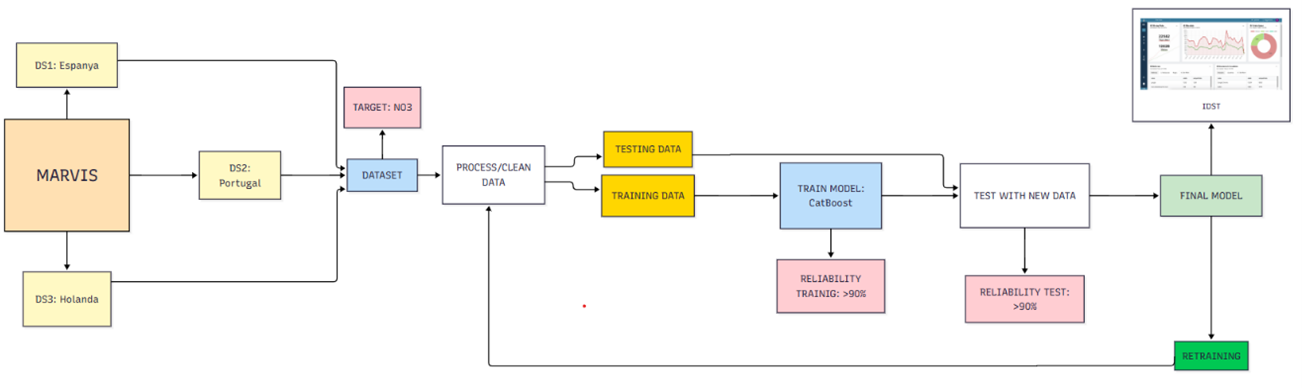
Figure 1: MARVIS training flow from the 3 pilot sites (DS)
Nitrate is a key focus due to its prevalence as a groundwater contaminant, primarily from agricultural sources, and the strict regulatory limits imposed by drinking water standards. MARVIS’s AI core initially utilizes robust models like XGBoost, which are efficient with smaller datasets, and is designed to evolve to more complex neural networks as the volume of monitoring data grows. This progression allows the system to capture increasingly intricate non-linear relationships between the sensor inputs and the target contaminant concentration. For the end-user, the IDST provides a real-time dashboard with graphical visualizations of nitrate trends, historical data analysis, and, most importantly, an automated alert system that issues immediate notifications when concentrations approach or exceed predefined safety thresholds. This transforms water management from a reactive to a proactive endeavor. Furthermore, MARVIS is built for scalability; through transfer learning, a model trained and validated at one demonstration site can be rapidly adapted for use at a new site with a different hydrogeological context, significantly reducing the cost and time required for deployment. The use of explainability techniques like SHAP (SHapley Additive exPlanations) demystifies the AI’s “black box,” providing clear insights into which input parameters are most influential in a given prediction, thereby fostering greater trust and confidence in the tool’s outputs.
The MARVIS tool is seamlessly integrated into the broader IDST architecture, which is built upon the foundational principles of openness and interoperability. The IDST’s data core is powered by the ETSI NGSI-LD standard [2], a “common language” for data that enables disparate systems, models, and platforms to communicate and exchange information contextually. This is implemented using open-source components from the FIWARE [3] ecosystem (Stellio context broker), effectively creating a “digital twin” of the entire river basin and aquifer system. This dynamic virtual replica is continuously updated with data from physical sensors, the MARVIS virtual sensor, and the outputs of other integrated models.
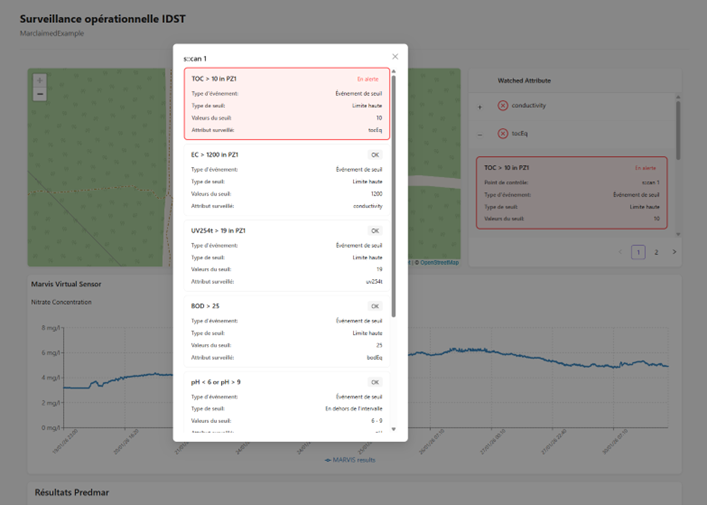
Figure 2: IDST monitoring and alerts interface mixing virtual and real sensing
The versatility and success of this open-architecture approach are demonstrated by its role as a foundational blueprint for subsequent research initiatives. The MARCLAIMED IDST is set to be the technological basis for the Urban Water Platform (UWP) in the new UrbaQuantum project [4]. UrbaQuantum expands the scope from rural and peri-urban groundwater management to the complexities of the complete urban water cycle, addressing challenges like combined sewer overflows (CSOs), urban runoff, and the presence of emerging contaminants such as microplastics and pathogens in bathing waters and wastewater treatment plant effluents. By leveraging the mature, scalable, and interoperable NGSI-LD framework of the IDST, UrbaQuantum can accelerate its development and focus on integrating a new generation of novel sensors and advanced hydrological models tailored for the urban environment.
ACKNOWLEDGEMENTS
This work was co-funded by the European Union under gr(ant agreement 101136799 (MARCLAIMED).
REFERENCES
[1] MARCLAIMED, “Supporting decision-making and adaptation policies to address water scarcity and water stress
”, Horizon Europe funded project ID 101136799, https://marclaimed.eu/
[2] ETSI GS CIM 009 V1.9.1, 2025, NGSI-LD API
[3] FIWARE, “the Open Source Platform for Our Smart Digital Future”, https://www.fiware.org/
[4] UrbaQuantum, “Revolutionizing urban water management with integrated sensing, modeling, and decision-support for sustainable, resilient cities.”, Horizon Europe funded project ID 101180452, https://urbaquantum.eu